
The Large Open Pit (LOP) project is an international research and technology transfer project focused on the engineering of large slopes associated with open pit mines. It is an industry-sponsored and funded project that was initiated in 2005. Among the initiatives mandated by the LOP sponsors was the development of a series of guidelines on the state-of-practice related to the design and stability of large slopes associated with open pit mines. The dissemination of the knowledge that has been created through LOP Guidelines (see here) and supporting research initiatives, and the education and training of the professionals who work in open pit mining, are also mandates of the LOP. To facilitate this dissemination, and education and training, the LOP Sponsors have agreed to allocate a separate budget for Education and Training under LOP III.
In collaborating with WSP Mining, the following training webinars on Guidelines for Sampling and Laboratory Testing of Strong Rock for Open Pit Operations have been developed in English, Spanish, Portuguese, and French. If you have any questions about the content, feel free to reach out to the LOP team (here) or any of the WSP contributors listed below.
- Module 1: Sample Collection, Sharon Ross
- Module 2: Point Load Testing, Natalie Solis
- Module 3: UCS Testing, Kate Condon
- Module 4: Triaxial Testing, Marc Rougier
- Module 5: Direct Shear Testing, Luiz Meira de Castro and Sarah Cox, P.E.
- Module 6: Failure Envelopes, Marisol Valerio
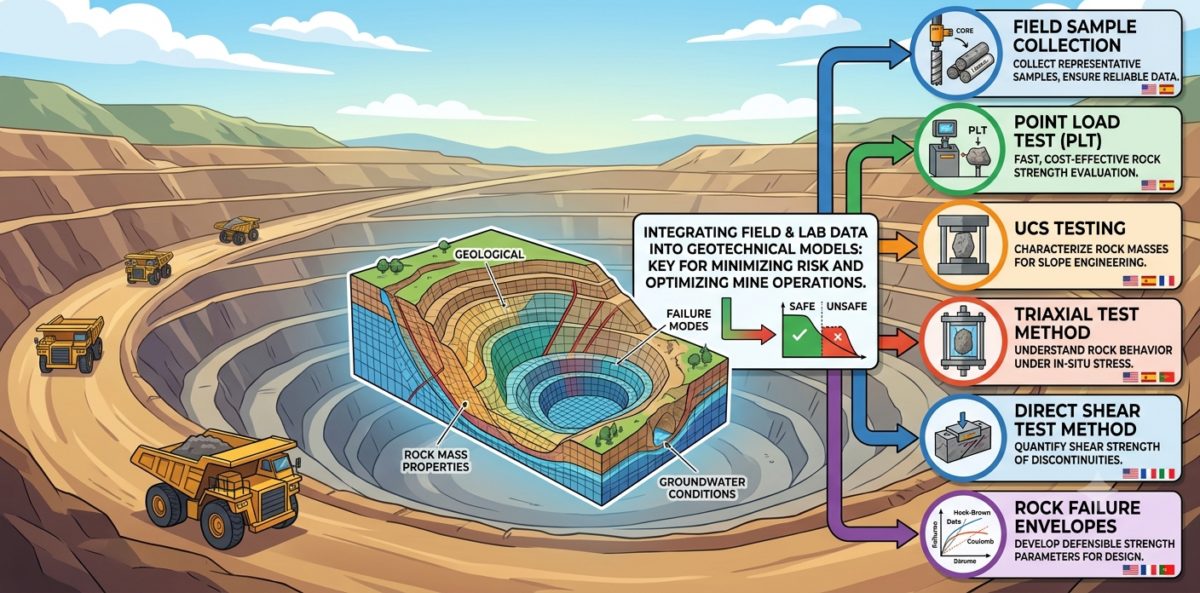
Field Sample Collection: This webinar provides practical guidance for collecting representative rock samples and preparing laboratory testing programs for open pit slope engineering. Developed through the Large Open Pit (LOP) Project and presented by WSP, it outlines industry best practices for sampling hard rock materials (ISRM R3-R6 strength classes) used in geotechnical investigations and slope stability assessments. The webinar covers sample selection criteria, specimen size requirements, sampling frequencies, drilling and core recovery techniques, sample labelling, packaging, moisture preservation, and transport procedures. It also explains how to design and update effective sampling programs, ensuring laboratory test results are reliable, representative, and suitable for geotechnical modelling and mine design. The guidance is based on recognised ISRM and ASTM standards and is intended for geotechnical engineers, engineering geologists, mine geologists, and mining professionals involved in open pit slope investigations and rock mass characterisation. Watch it in English, español, français, or português.
Point Load Test Method: This webinar explores how Point Load Testing (PLT) can be used as a fast, practical, and cost-effective tool for evaluating rock strength in open pit mining operations. Participants will learn how to design and implement systematic PLT testing programs, collect high-quality field data, and use results to improve rock mass characterisation and geotechnical decision-making. The session covers industry best practices for testing procedures, safety considerations, data management, quality assurance, and interpretation of results in accordance with ASTM and ISRM guidelines. It also discusses the limitations of generic strength correlations and demonstrates the importance of developing site-specific relationships between PLT and laboratory testing results. Ideal for geotechnical engineers, geologists, and mining professionals, this webinar provides practical insights for building reliable rock strength databases and improving confidence in slope design and risk assessments. Watch it in English, español, français, or português.
UCS Testing: This webinar explores the role of Uniaxial Compressive Strength (UCS) testing in the characterisation of rock masses for open pit slope engineering. Rather than focusing solely on laboratory procedures, the session demonstrates how UCS data should be collected, validated, interpreted, and integrated into geotechnical design. Participants will learn how sample selection, specimen preparation, testing standards, rock heterogeneity, anisotropy, weathering, and alteration can influence measured rock strength. The webinar also highlights the importance of classifying failure types and failure modes, identifying invalid test results, and combining UCS data with field observations and Point Load Test (PLT) results to develop representative strength models. Designed for geotechnical engineers, engineering geologists, and mining professionals, this webinar provides practical guidance for transforming laboratory test results into reliable engineering parameters for slope design and geotechnical risk management. Watch it in English, español, français, or português.
Triaxial Test Method:This webinar takes a practical engineering approach to triaxial rock testing and its application to open pit slope design. Rather than treating laboratory testing as a standalone exercise, the session focuses on how Triaxial Compressive Strength (TCS) data can be used to better understand rock behaviour under in-situ stress conditions and improve the reliability of geotechnical models. It discusses how to select representative confinement pressures, design effective testing programmes, distinguish valid from invalid test results, and interpret failure mechanisms in both homogeneous and heterogeneous rock masses. Particular attention is given to the influence of anisotropy, weathering, and geological structures on rock strength, as well as the development of realistic strength envelopes for engineering design. The webinar is intended for geotechnical engineers, engineering geologists, and mining professionals seeking to apply laboratory testing data more effectively to open pit slope stability assessments and risk-informed mine design. Watch it in English, español, français, or português.
Direct Shear Test Method: This webinar focuses on one of the most critical controls on open pit slope stability: the shear strength of rock discontinuities. Through practical examples and industry guidance, participants will learn how direct shear testing is used to quantify the behaviour of joints, faults, bedding planes, foliations, and other geological structures that commonly control slope failures. The session covers sample selection and preservation, laboratory testing methods, selection of representative normal stresses, interpretation of peak and residual shear strength, and the influence of roughness, infill materials, weathering, and scale effects. It also discusses common testing challenges, quality control considerations, and the development of shear strength envelopes for engineering design. Designed for geotechnical engineers, engineering geologists, and mining professionals, this webinar provides practical knowledge for converting laboratory test results into reliable parameters for slope stability analyses and geotechnical risk management in open pit mines. Watch it in English, español, français, or português.